


Trade Promotion Execution: How CPG Brands Make Sure Promotions Happen In-Store

Trade promotion execution is the stage of trade promotion management where a promotion agreed between a CPG brand and a retailer is implemented in store: the right products, at the right price, in the right place, with the right materials, for the full promotional period. Planning decides what a promotion should look like. Execution decides whether shoppers actually see it. This guide explains where execution fits in trade promotion management, why promotions fail at store level, which KPIs to track and how to measure execution during field visits.
- Definition: Trade promotion execution turns a negotiated promotion into what shoppers see on the shelf and in secondary locations.
- Place in TPM: Trade promotion management covers planning, execution and analysis. Execution is where most promotions break down.
- KPIs: Track product presence, price, display, materials, timing and stockouts during the promotional window.
- Frequency: Promotions run for weeks, not months. Infrequent audits miss most execution failures.
- Granularity: National averages hide store-level gaps. Execution must be visible store by store.
- Action: Measurement only pays off when gaps are fixed while the promotion is still running.
What Is Trade Promotion Execution?
Trade promotion execution is the implementation of a trade promotion at the point of sale, as agreed between a manufacturer and a retailer. A promotion is well executed when every element of the agreement is visible to shoppers at the same time, in the agreed stores, during the agreed period.
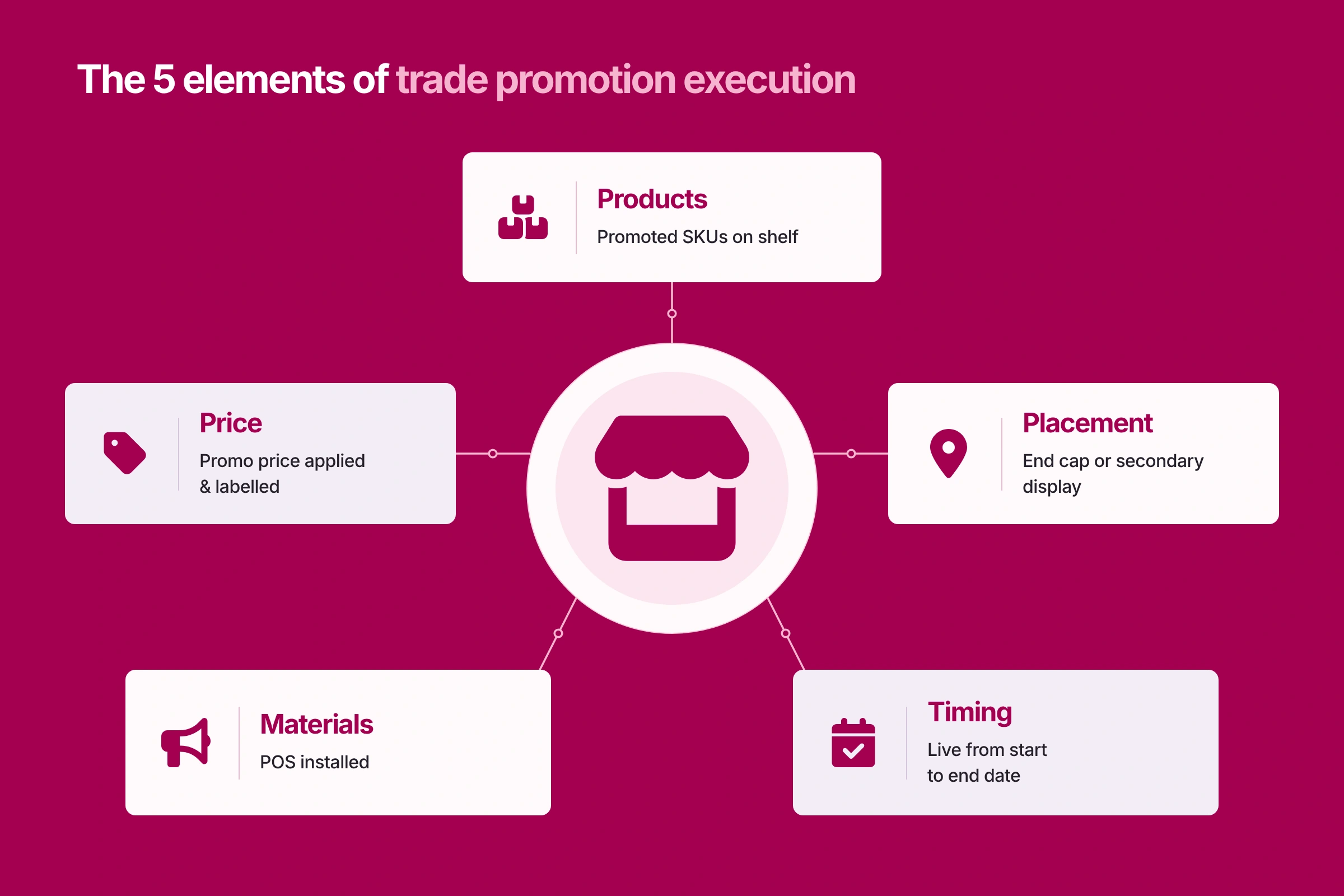
A typical trade promotion agreement covers several elements:
- Products: the promoted SKUs are on shelf and in stock.
- Price: the temporary price reduction is applied and correctly labelled.
- Placement: the products sit in the agreed location, such as an end cap, a secondary display or a specific shelf level.
- Materials: point-of-sale (POS) materials such as shelf strips, wobblers or display units are installed.
- Timing: the promotion starts and ends on the agreed dates.
The degree to which these elements are in place is often called promotional compliance. Trade promotion execution sits alongside other retail execution measures, such as planogram compliance and on-shelf availability, and many brands include it in their Perfect Store scoring.
Where Does Execution Fit in Trade Promotion Management?
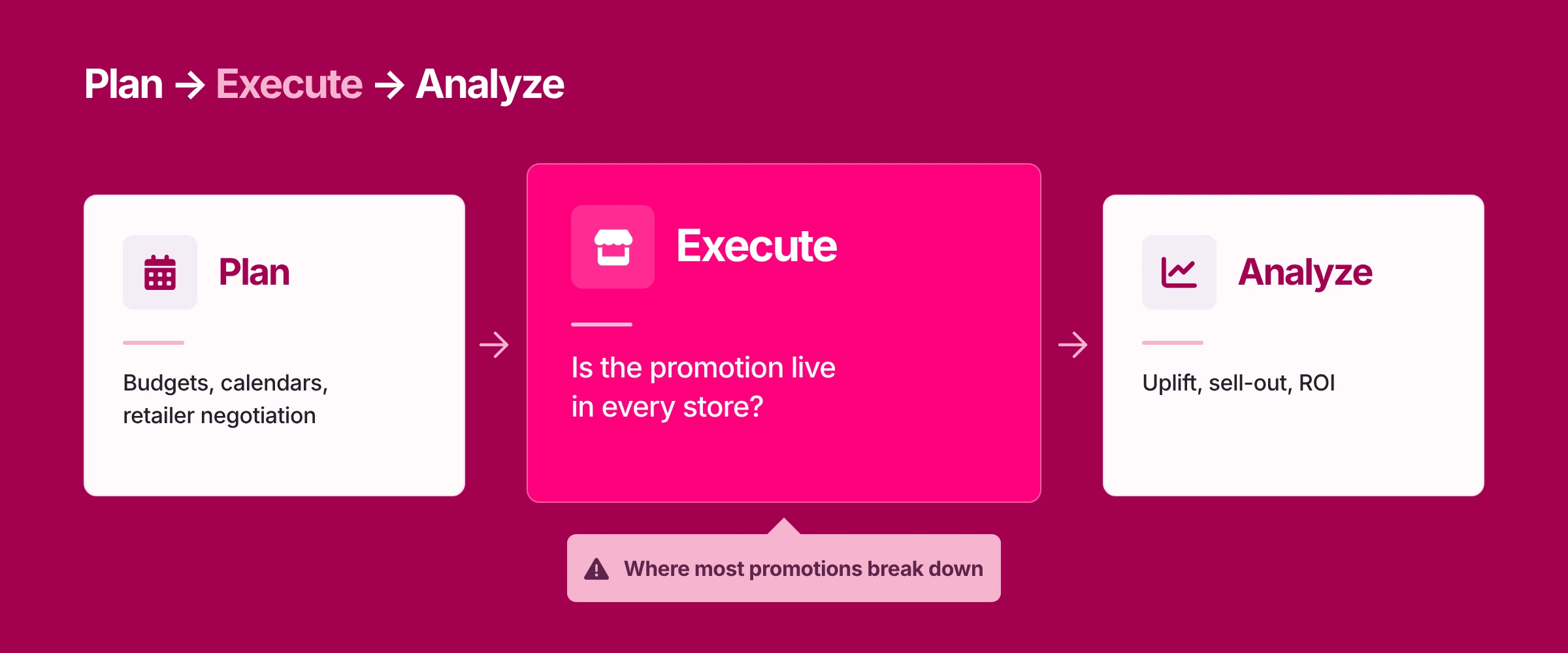
Trade promotion management (TPM) is usually described in three stages: planning, execution and analysis. Most TPM software focuses on the first and last stages. Execution, the moment the promotion reaches the store, is often the least visible.
| Stage | Main question | Typical owner | Typical data |
|---|---|---|---|
| Planning | Which promotions, with which retailer, at what cost? | Trade marketing, key account managers, finance | Budgets, calendars, forecasts |
| Execution | Is the agreed promotion actually live in each store? | Field sales and merchandising teams | Store visits, shelf and display data |
| Analysis | Did the promotion deliver the expected results? | Revenue growth management, finance | Sell-out, uplift, ROI |
The three stages depend on each other. A promotion that was well planned but poorly executed will look like a weak promotion in the post-event analysis, even if the offer itself was sound. Without execution data, brands cannot tell whether a promotion underperformed because of the mechanic or because it never properly reached the shelf.
Why Do Trade Promotions Fail In-Store?
Trade promotions usually fail for operational reasons, not strategic ones. The promotion is sound on paper, but one element breaks down between the agreement and the shelf.
| Failure point | What happens in store | Typical consequence |
|---|---|---|
| Stock | Promoted products are out of stock or not delivered in time | Shoppers cannot buy the offer |
| Price | The promotional price is not applied, or the label shows the regular price | The offer is invisible or creates checkout disputes |
| Placement | The secondary display is not built, or is placed in a low-traffic area | Incremental volume does not materialise |
| Materials | POS materials are not delivered, not installed or removed early | Shoppers do not notice the promotion |
| Timing | The promotion starts late or ends early | Part of the paid promotional period is lost |
| Competition | A competitor occupies the agreed space | The brand pays for visibility it does not get |
Each of these failures can occur in a single store while the promotion runs correctly elsewhere. That is why trade promotion execution has to be checked store by store, not inferred from sell-in data.
Which KPIs Measure Trade Promotion Execution?
The most useful trade promotion execution KPIs map directly to the elements of the agreement. Each KPI answers one question per store, which can then be aggregated by retailer, region or team.
| KPI | Question it answers | Scope |
|---|---|---|
| Promotional presence | Are all promoted SKUs on shelf? | Per SKU, per store |
| Price compliance | Is the promotional price applied and correctly labelled? | Per SKU, per store |
| Display compliance | Is the agreed secondary display or end cap in place? | Per display, per store |
| POS material compliance | Are the agreed promotional materials installed? | Per material, per store |
| Timing compliance | Was the promotion live on the start date and still live at the end? | Per store, per period |
| Stockouts during the promotion | Did promoted products run out while the promotion was active? | Per SKU, per store |
| Share of promotional space | How much of the promotional area does the brand occupy versus competitors? | Per category, per store |
These indicators are often combined into a single promotional compliance rate:
Promotional compliance rate = (Stores where all agreed elements are in place ÷ Stores audited) × 100
Some brands weight each element differently. A missing promotional price, for example, may weigh more than a missing shelf strip. The weighting should reflect what drives promotional sales in your category, and it should stay stable so results can be compared across campaigns.
How Do You Measure Trade Promotion Execution in Store?
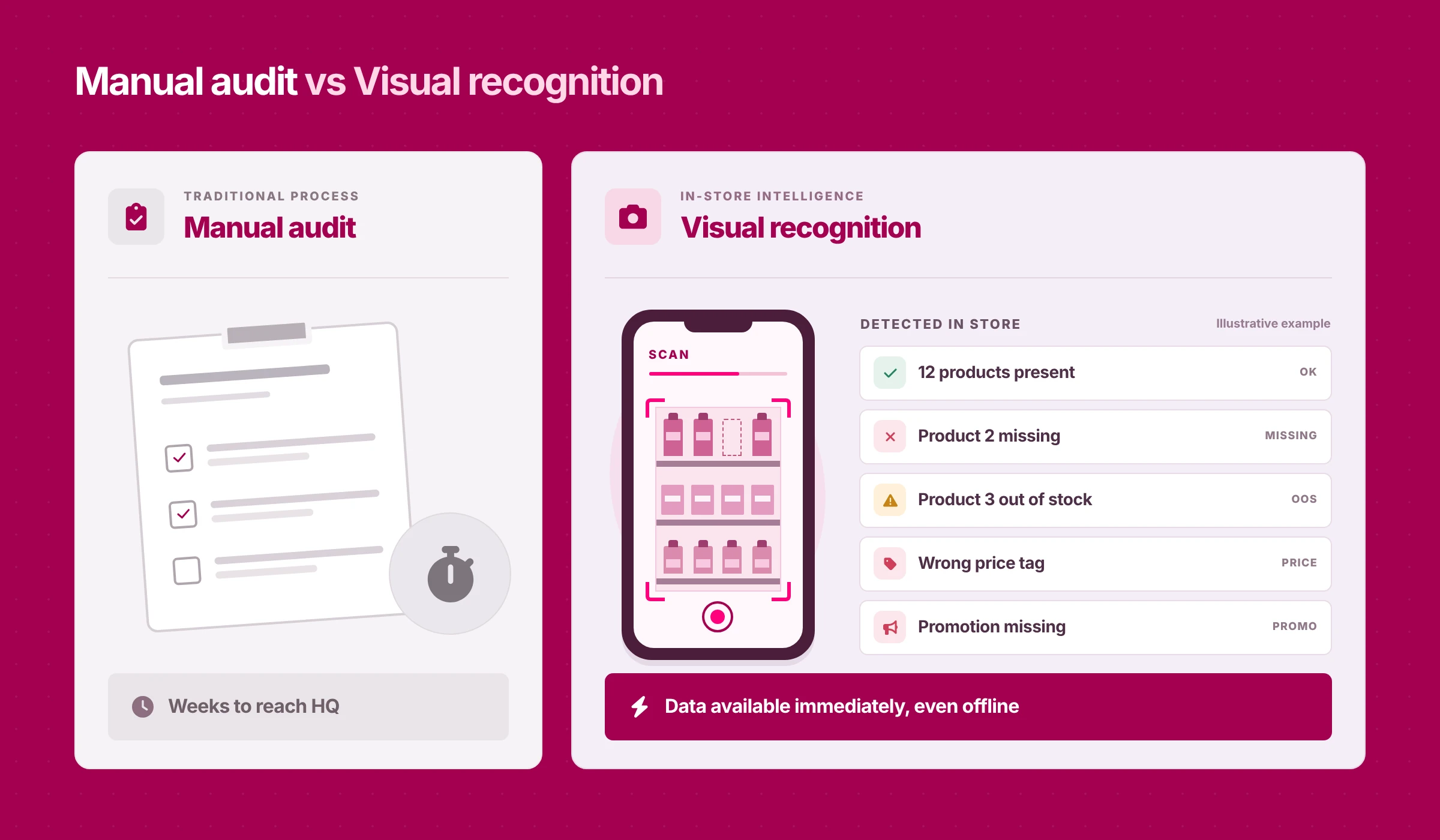
Trade promotion execution is measured during store visits, either manually through forms and photos or automatically with image or video recognition. The method determines how often you can measure and how quickly results reach decision-makers.
| Manual audit | Automated audit with visual recognition | |
|---|---|---|
| Data capture | Rep counts products, checks prices and fills a form | Rep captures the shelf or display; software extracts the data |
| Time per check | Grows with the number of SKUs and elements | Largely independent of the number of SKUs |
| Consistency | Depends on each rep’s interpretation | Same rules applied in every store |
| Visibility at HQ | Often delayed until forms are consolidated | Available shortly after capture |
| Realistic frequency | Limited by visit time | Can be included in every visit |
Frequency matters more for promotions than for any other execution KPI. A promotion may run for one to four weeks. If execution is only checked a few times a year, most promotions are never measured at all.
Faster capture changes what is possible. At Mondelez Benelux, quicker shelf data collection allowed the team to monitor execution “once a month instead of twice a year”, according to Mondelez Benelux’s experience with EasyPicky. For promotions, that kind of shift is the difference between auditing a campaign and missing it entirely.
When evaluating a measurement method, check three things: whether it captures every element of your promotional agreement (including price and secondary displays), whether it works in real store conditions, and how quickly the data reaches the people who can act on it. The digitisation of field audits is often the first step.
Why Do National Averages Hide Execution Failures?
A national execution rate can look healthy while a significant number of stores fail to deliver the promotion. An 85% compliance rate still means that roughly one store in seven is not delivering the agreed offer, and those stores are rarely random. They often cluster by retailer, region, store format or field team.
For trade promotion execution, this means reporting at several levels:
- Store level, to trigger corrective action in specific stores.
- Retailer and banner level, to support negotiations and joint business plan reviews.
- Region or field-team level, to identify coaching or capacity issues.
- Element level, to see whether price, displays or materials fail most often.
How Do You Fix Execution Gaps While a Promotion Is Live?
Execution data creates value only when gaps are corrected while the promotion is still running. A report delivered after the campaign ends documents the loss without recovering it.
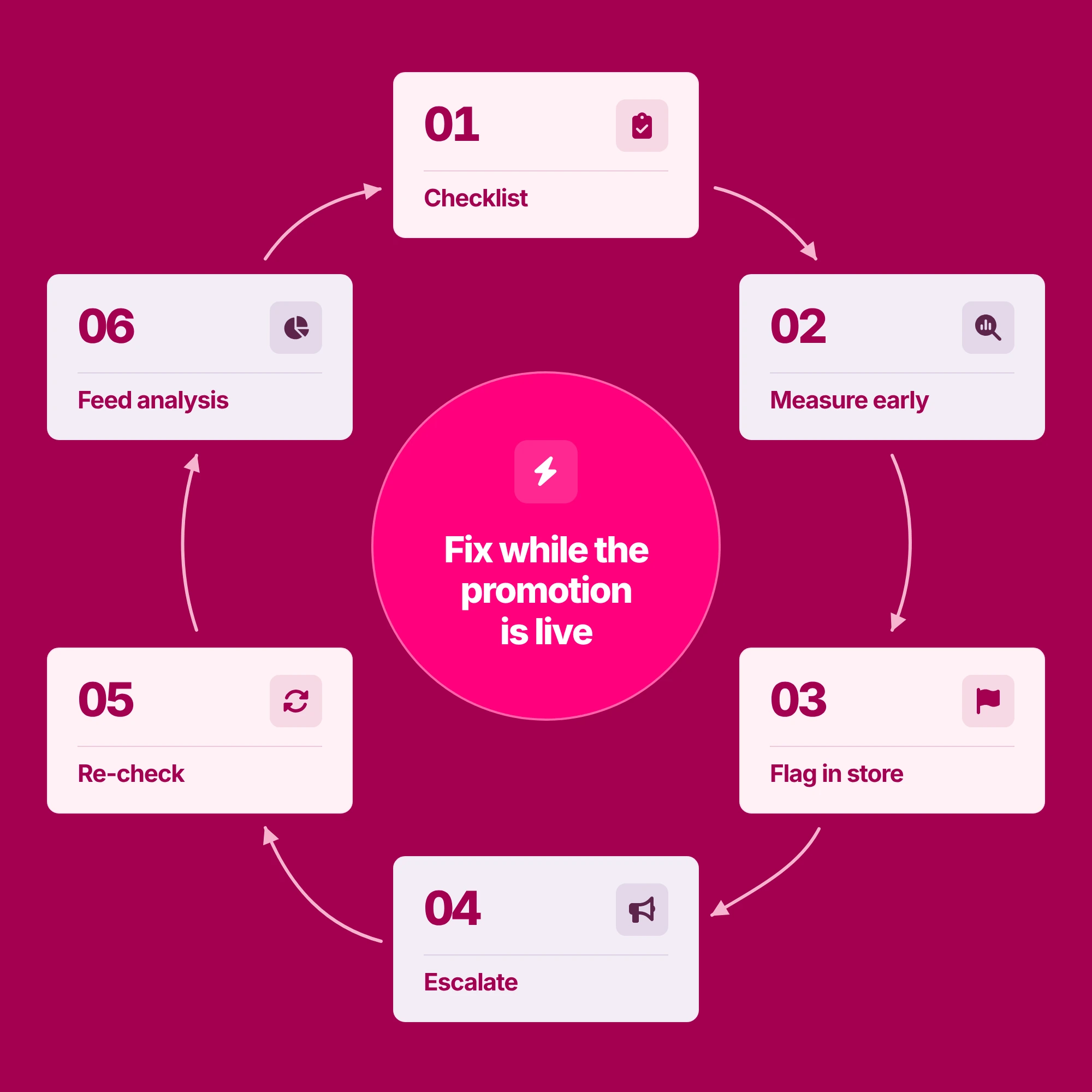
A practical correction loop looks like this:
- Turn the agreement into a checklist. Translate each promotion into the specific elements a rep must verify: SKUs, price, display, materials, dates.
- Measure early in the promotion. Prioritise visits in the first days of the campaign, when correction still has time to pay off.
- Flag gaps during the visit. The rep should know immediately which element is missing, so it can be fixed with the store manager on the spot.
- Escalate what the rep cannot fix. Delivery failures or retailer-side pricing errors go to the key account manager.
- Re-check non-compliant stores. Plan a follow-up visit for stores that failed, before the promotion ends.
- Feed the analysis stage. Share execution results with the teams running post-event analysis, so they can separate a weak offer from a weak execution.
The same data also strengthens conversations with retailers. Store-level evidence of missing displays or wrong prices supports a factual discussion about the execution the brand has paid for.
Building a Trade Promotion Execution Program That Holds Up
A reliable trade promotion execution program rests on four decisions: a clear definition of what “executed” means for each promotion, a short list of KPIs tied to the agreement, a measurement frequency that matches the length of your promotions, and a correction loop that acts while the promotion is live.
The measurement method is usually the constraint. When audits are slow, brands measure less often, report later and correct less. Automated capture with visual recognition removes much of that constraint by turning a shelf or display capture into structured execution data during the visit, with the same rules applied in every store. EasyPicky’s Field App uses video recognition to do this for field teams, and the KPIs it can capture can be configured to each brand’s execution methodology.
Whatever the tool, the goal stays the same: make sure the promotion you planned and paid for is the promotion shoppers see.
See EasyPicky in action
See how your field teams can measure in-store execution, promotions included, during every visit.
Frequently asked questions
What is the difference between trade promotion management and trade promotion execution?
Trade promotion management (TPM) is the full process of planning, executing and analysing trade promotions. Trade promotion execution is one stage of that process: the implementation of the promotion in store. TPM software typically handles budgets, calendars and post-event analysis, while execution is verified by field teams during store visits.
What is promotional compliance?
Promotional compliance measures how closely a promotion in store matches what was agreed with the retailer: products, price, placement, materials and timing. It is the main way brands quantify the quality of trade promotion execution.
How often should trade promotion execution be checked?
Ideally at least once early in every promotion, then again in stores that failed. Because most promotions run for a few weeks, audits planned only a few times a year will miss most campaigns.
Can image recognition measure trade promotion execution?
Image and video recognition can identify products, facings, prices and shelf positions from a capture, which covers several execution KPIs automatically. Coverage of specific elements, such as secondary displays or particular POS materials, depends on how the solution is configured for each brand.
Who is responsible for trade promotion execution?
Responsibility is usually shared. Trade marketing defines the promotion, key account managers negotiate it with retailers, and field teams verify and correct execution in store. Clear ownership of each correction step is what makes an execution program effective.