


Traditional Trade vs Modern Trade: What's the Difference?
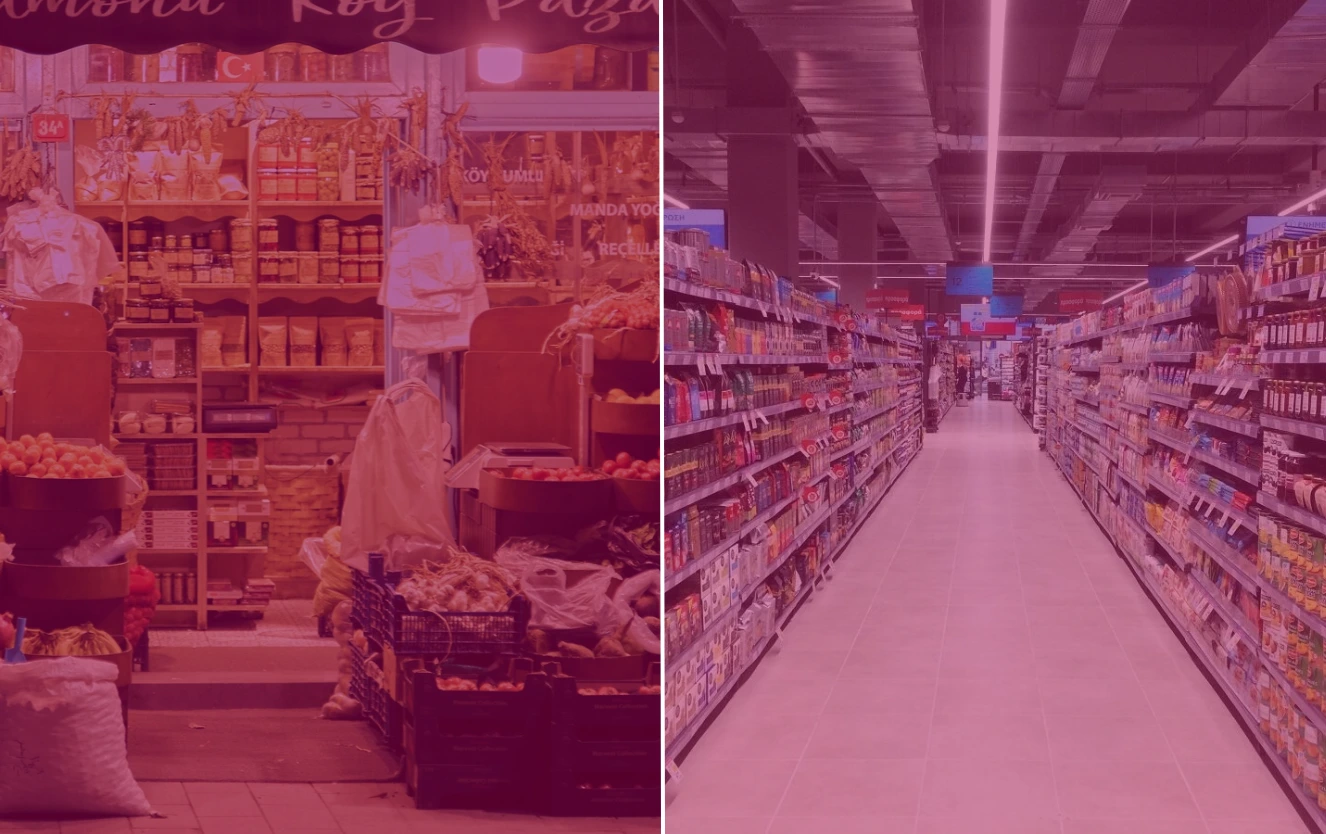
Traditional trade consists mainly of independent and smaller retailers, while modern trade refers to organized retail chains with centralized purchasing and more standardized processes. The key difference is therefore not simply store size, but how retailers are owned, managed, supplied, and monitored.
For FMCG brands, understanding this difference is important because each channel creates different challenges for distribution, data collection, and in-store execution.
What is traditional trade?
Traditional trade refers to independent or small-scale retail outlets typically managed by individual owners or small businesses.
Examples include:
- Independent grocery stores
- Neighborhood shops
- Small convenience stores
- Local markets
- Independent pharmacies
- Small food and beverage retailers
Traditional trade remains an important retail channel in many markets, particularly where neighborhood stores play a significant role in consumers’ daily shopping habits.
Its defining characteristic is fragmentation. Instead of working with a limited number of large retail chains, FMCG brands may need to manage thousands of individual points of sale.
As a result, assortment, pricing, shelf organization, and promotional execution can vary significantly from one store to another.
For field teams, this creates a basic challenge: how can brands maintain visibility and consistency across such a large and diverse store network?
What is modern trade?
Modern trade refers to organized retail networks operating through centralized management, structured purchasing, and more standardized processes.
Typical examples include:
- Supermarkets
- Hypermarkets
- Cash & carry stores
- Large convenience chains
- Organized drugstores
- Retail chains
Modern trade generally relies on centralized purchasing, standardized assortments, negotiated promotions, and structured relationships between retailers and suppliers.
This can make it easier for FMCG brands to define commercial agreements and monitor performance across a retail network.
However, centralized planning does not automatically mean consistent execution in every store.
A promotion can be planned centrally, for example, while its display, availability, or visibility still varies from one location to another.
Traditional Trade vs Modern Trade: What are the key differences?
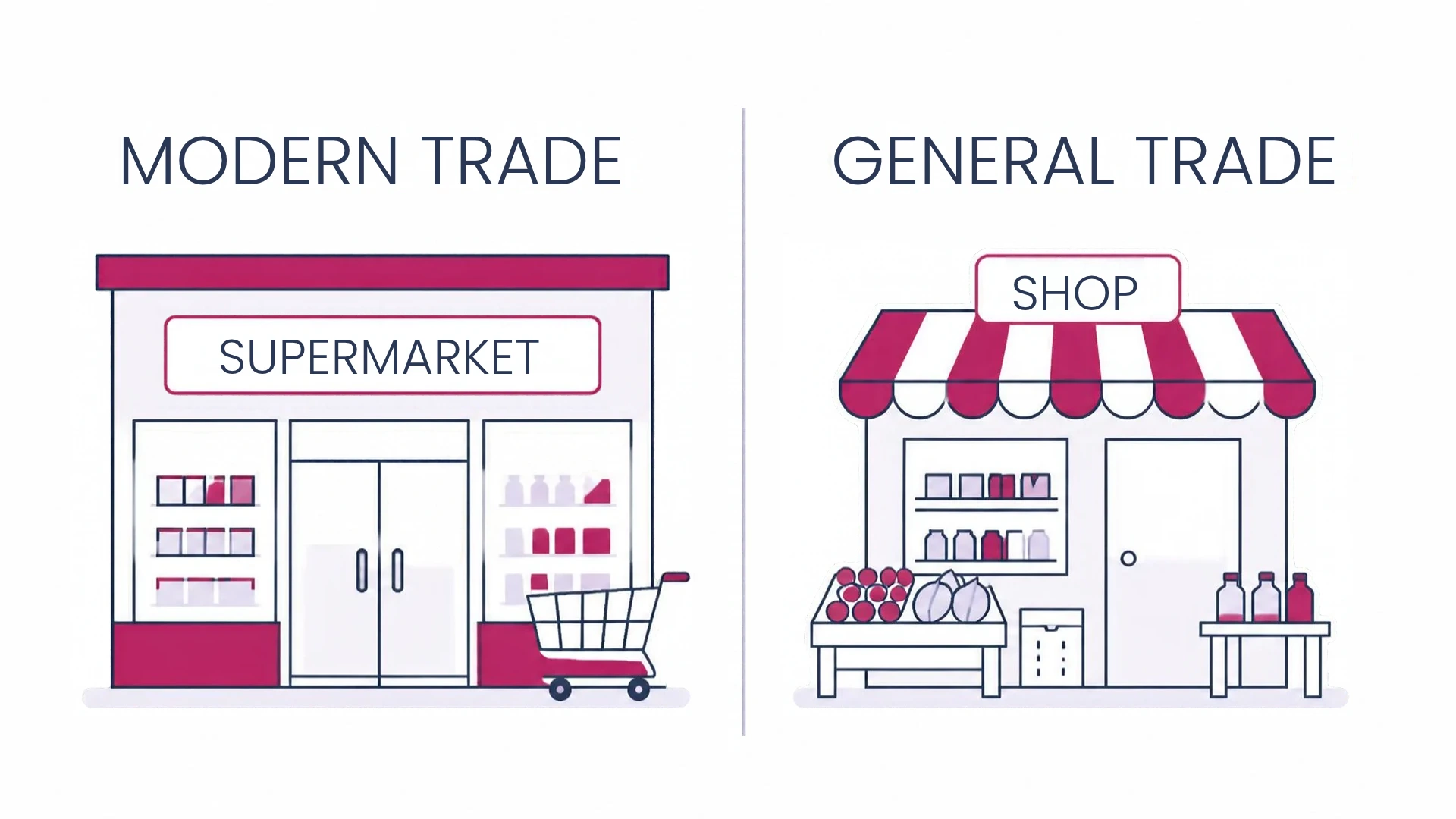
The main difference between traditional and modern trade lies in how retail is organized and managed.
| Traditional Trade | Modern Trade | |
|---|---|---|
| Store ownership | Mostly independent | Usually part of a retail chain |
| Store network | Highly fragmented | More centralized |
| Store size | Generally smaller | Generally larger |
| Purchasing | Often decentralized | Often centralized |
| Assortment | Can vary significantly by store | More standardized |
| Promotions | Often locally driven | Often centrally planned |
| Data availability | Often limited or fragmented | Generally more structured |
| Execution monitoring | Harder to scale | Generally easier to standardize |
The distinction is not absolute. Retail formats vary by country, retailer, and category, and some stores combine characteristics of both models.
But the difference in retail structure has a direct impact on how FMCG brands collect information and manage execution in the field.
Why does the difference matter for FMCG brands?
Traditional and modern trade create different challenges for distribution, data collection, and in-store execution.
In both channels, getting a product listed is only the starting point. Brands also need to make sure that products are:
- Available
- Correctly placed
- Properly displayed
- Supported by the right promotions
- Visible to shoppers
This is where in-store execution becomes critical.
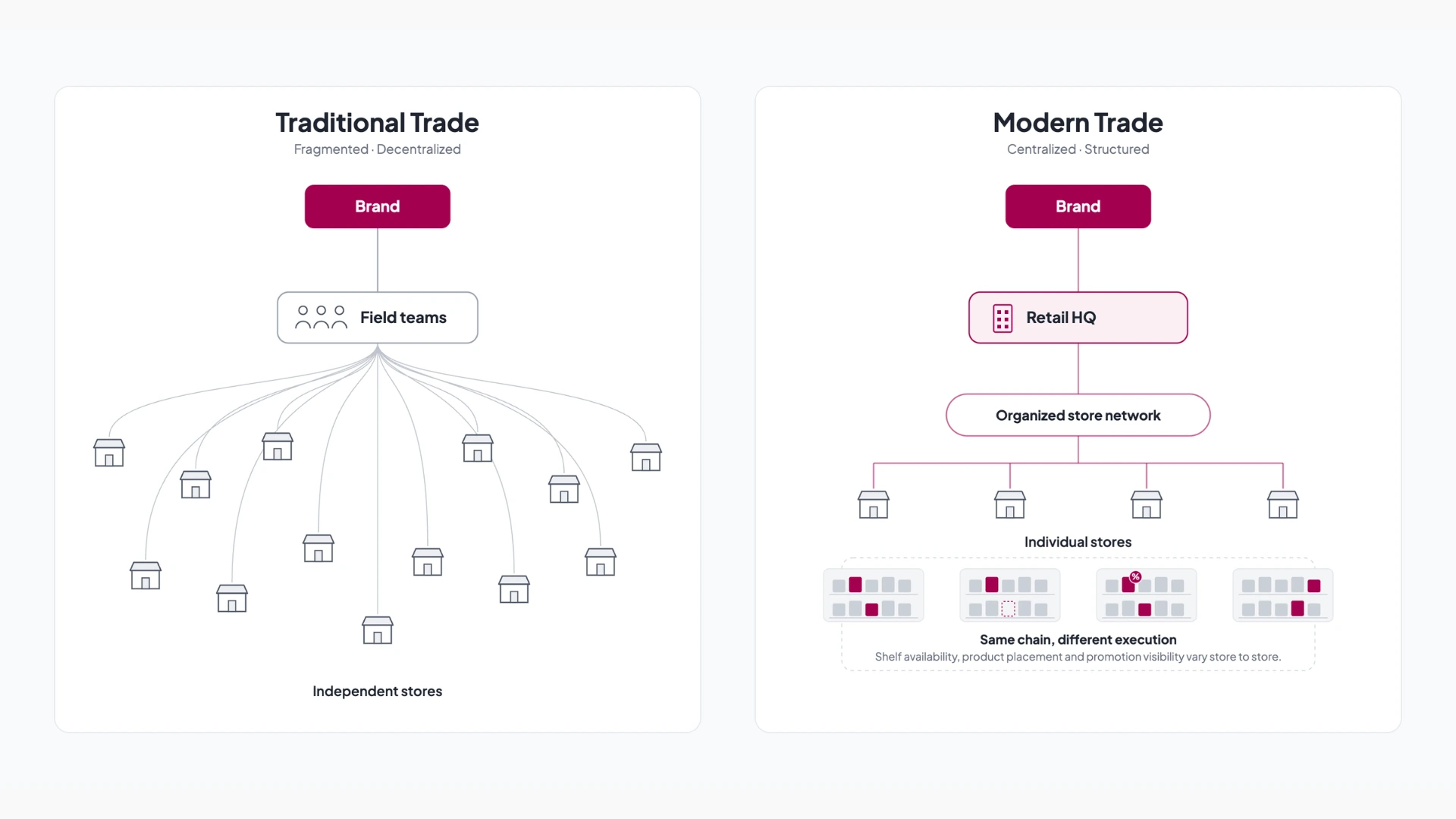
In traditional trade, the main challenge is often scale and fragmentation. A field team may need to visit a large number of independent stores, each with different assortments and store conditions.
In modern trade, the challenge is often consistency. Commercial agreements and promotional plans may be centralized, but their execution can still vary between stores.
How can image recognition improve visibility across traditional and modern trade?
Image recognition can help FMCG brands measure in-store execution across both traditional and modern trade, but it addresses different challenges in each channel.
In traditional trade, the main challenge is scale. Brands may need to monitor a large number of independent stores, often with different assortments, shelf layouts and levels of execution. Collecting consistent store-level data manually can therefore be difficult and time-consuming.
With image recognition, field teams can use a smartphone or tablet to capture shelf images and automatically identify products, availability, facings, prices, promotions and competitor presence. This helps brands turn visits across a fragmented store network into structured, comparable data.
In modern trade, the challenge is less about fragmentation and more about consistency with centrally defined execution standards. A promotion, assortment or merchandising plan may be agreed at retailer level, but its implementation can still vary from one store to another.
Image recognition can help field teams verify whether the expected execution is actually visible on the shelf: are the right SKUs present? Are the required facings respected? Is the promotion correctly displayed? Is the shelf share aligned with the plan?
In both channels, the objective is the same: move from assumptions about store execution to measurable visibility at the point of sale.
From store videos to actionable retail data
The value of image recognition is not simply identifying products in a video. It is turning what is visible in-store into structured data that can be compared, monitored and connected to business KPIs.
Traditional Trade
Many stores → many field visits → image recognition → standardized execution data → identify gaps at scale
Modern Trade
Centralized plan → store visits → image recognition → execution data → identify deviations from the plan
This gives FMCG teams a more consistent way to understand what is happening across different retail environments.
Conclusion: From retail strategy to store reality
Traditional Trade and Modern Trade operate differently, and so do the challenges they create for FMCG brands.
In Traditional Trade, the challenge is gaining consistent visibility across a fragmented network of independent stores. In Modern Trade, it is making sure centrally defined plans are actually executed consistently at store level.
In both cases, what is planned centrally is not necessarily what happens on the shelf.
Image recognition can help bridge this gap by turning store images into structured, measurable data, making it easier for brands to monitor availability, assortment, facings, promotions and competitor presence across different retail environments.
The objective is not to treat Traditional Trade and Modern Trade in the same way. It is to give field and commercial teams the visibility they need to act on the specific execution challenges of each channel.
See EasyPicky in action
EasyPicky uses image recognition to help FMCG brands turn store-level observations into actionable retail data and improve in-store execution at scale.
Frequently asked questions
What is the main difference between traditional trade and modern trade?
Traditional trade is mainly composed of independent and smaller retail outlets, while modern trade consists of organized retail chains with centralized management and more standardized processes.
Is traditional trade more fragmented than modern trade?
Yes. Traditional trade typically involves a larger number of independent retailers, while modern trade is generally organized around centralized retail groups and chains.
Which retail channel provides more data?
Modern trade generally provides more structured commercial data because of its centralized systems. However, structured data does not necessarily provide complete visibility into in-store execution.
Why is in-store execution important in modern trade?
Centralized agreements and promotional plans do not guarantee identical execution in every store. Store-level monitoring can help brands identify differences between planned and actual execution.
Can image recognition be used in traditional and modern trade?
Yes. Image recognition can analyze store-level execution across different retail formats by turning shelf images into structured data on products, availability, facings, promotions, and visibility.